
How to Win Tri-Alliance Clash
This is a server event where 3 alliances compete by capturing buildings. At the end of the 1-hour battle, the alliance with the highest total score wins.
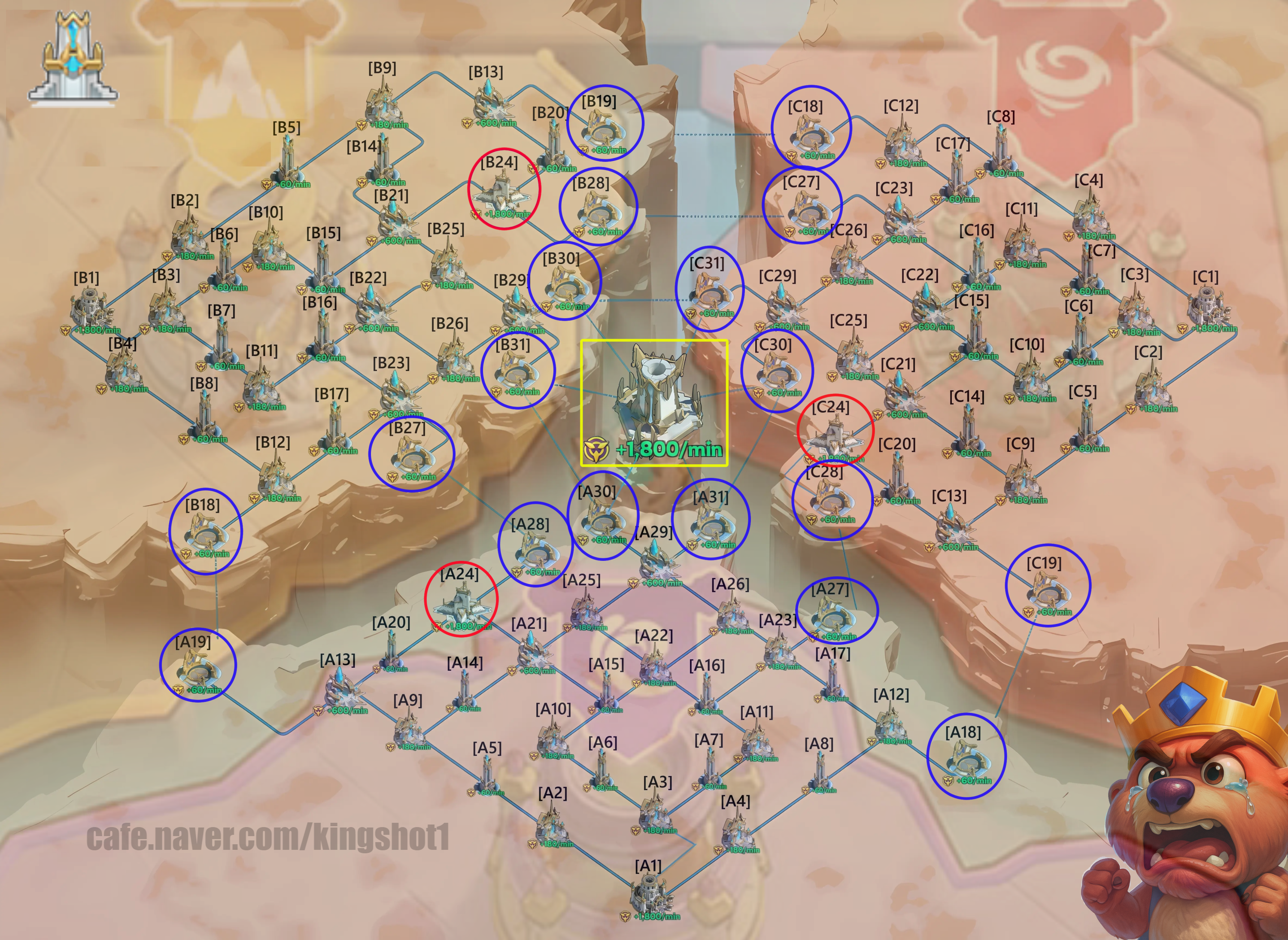
Rules at a Glance
Entry Requirements (Summary)
- Alliance must rank in the top 20 by alliance power
- Squad 1 is usually unlocked by default
- Example unlock for Squad 2: Alliance Lv.6+ and 40 cumulative active logins
- If participants + substitutes total 15 or more, Squad 2 can be counted separately
- Players must be in an alliance and usually need City Center Lv.16+, while 5+ days of inactivity may restrict entry
Basic Rules (Operations)
- Voting, sign-up, matchmaking, and battle timing follow the server calendar
- R4+ members can usually adjust sign-ups and participant lists
- Up to 30 participants plus 10 substitutes may be allowed, depending on server rules
- Each alliance can operate up to 2 squads in separate battlefields
- Each Governor can deploy up to 3 marches
Key Point Registration affects the result directly. Only register players who can actually show up and fight.
4 Battle Stages
| Stage | Time | Main Goal |
|---|---|---|
| 1) Preparation | 3 min | Assign roles, confirm routes, and organize opening capture plans |
| 2) Seize & Conquer | 17 min | Secure your own zone and steal some smaller enemy buildings while Garrisons are still protected |
| 3) Garrison Occupation | 20 min | A24 / B24 / C24 unlock. Garrisons give strong points per minute and often decide the match |
| 4) Temple Onslaught | 20 min | At 40 minutes, the Temple of Tides opens. First capture plus hold points decide the final outcome |
Key Timings 20 minutes (Garrisons) / 40 minutes (Temple). Saving energy for these moments is one of the biggest win conditions.
Registration, Attendance, and Voice Setup
1) Registration
- Only register players who can really attend. Fake or inactive sign-ups hurt both matchmaking and actual battle performance.
- Having R4+ members present is recommended because they can assign Captains after capturing objectives, which helps energy recovery.
2) Voice Communication
- Discord voice is highly recommended. Ideally, at least 1 to 3 leaders should be able to make real-time calls.
- Real-time voice is much faster than chat, especially during the 20-minute Garrison fights and the 40-minute Temple timing.
Recommended Team Setup
The main goal is to run both point production (capture / hold) and key-object defense at the same time.
Attack Team
- Push into enemy territory → take buildings → pressure Garrisons at 20 minutes → rush the Temple at 40 minutes
- Your strongest marches should usually go here first
Defense Team 1 / 2
- Defend your key routes and Transit Hubs
- After 20 minutes, holding your own Garrison becomes the top priority
Floaters
- Backup / reinforcement role that supports offense or defense depending on the situation
- They should save energy and react to sudden swings in the match
Heroes / March Choice
- Each Governor uses 3 marches, which means a total of 9 heroes in the battlefield rotation
- It is often effective to save one strongest march for Garrison and Temple timing
Stage-by-Stage Strategy
Stage 1–2 (0–20 min): Preparation + Early Expansion
- At the start, secure your own-side buildings and take your Transit Hubs as quickly as possible.
- Your Attack Team should steal a few smaller enemy buildings to gain early score and route advantage.
- The early objective is to establish a points-per-minute lead.
- Do not overspend energy: it is usually best to save around 30–40% for the 20-minute timing.
Stage 3 (20–40 min): Garrisons
- At 20 minutes, the Garrisons (A24 / B24 / C24) unlock.
- Priority 1: Hold your own Garrison. If you lose it, the score can swing very quickly.
- Priority 2: If possible, capture an enemy Garrison to widen the score gap.
- Floaters should be sent immediately to the area where the fight is starting to collapse.
Stage 4 (40–60 min): Temple of Tides
- At 40 minutes, the Temple of Tides opens. First-capture points are large, so timing the rush matters a lot.
- The Attack Team should focus on rushing and holding the Temple, while Defense teams protect the access routes (A29 / B29 / C29).
- Floaters should cut enemy reinforcements, retake or support connector buildings, and reinforce Temple defense.
Win Formula If you can do all four at once — hold your Garrison, secure first Temple capture, hold the Temple, and defend the access route — your win rate goes up sharply.
Practical Tips (Energy / Healing / Re-entry)
Energy Management
- Energy is consumed by movement, capturing, charging, retreating, and instant revive.
- After capturing a point, assigning a Captain helps with better energy recovery.
Re-entry / Buffs
- Once you leave the battlefield, there is usually a cooldown before re-entry. A 12-minute example rule is commonly used.
- Most buffs still apply except for some march speed or capacity related effects, but final rules always depend on the server version.
Wounds / Recovery
- If your troops are heavily damaged, retreating to a rear building, healing, and returning is often more efficient than instant revive.
- Healing and conscription are most efficient when done during small gaps between active fights.
FAQ
Q. Why does each side seem to have a different number of Ruin Clusters?
Map balance is often built around route distance, Transit Hub access, Garrison defense difficulty, and Temple entry stability, not just raw building count. That means a side with more Ruin Clusters may also carry more defense burden or harder control over critical connector routes. In practice, matches are usually decided less by ruin count and more by 20-minute Garrison control and 40-minute Temple execution.
Q. What is the single most important thing in this event?
Energy. If you spend too much of it early, you will have nothing left for the 20-minute and 40-minute swing points. Saving energy through Captain assignment, clear role separation, and proper Floater usage is one of the biggest keys to winning.